An interview with: Jacques de Beaufort
Updated: Jan 14
In discussion with the Florida based surrealist painter @jacquesdebeaufort
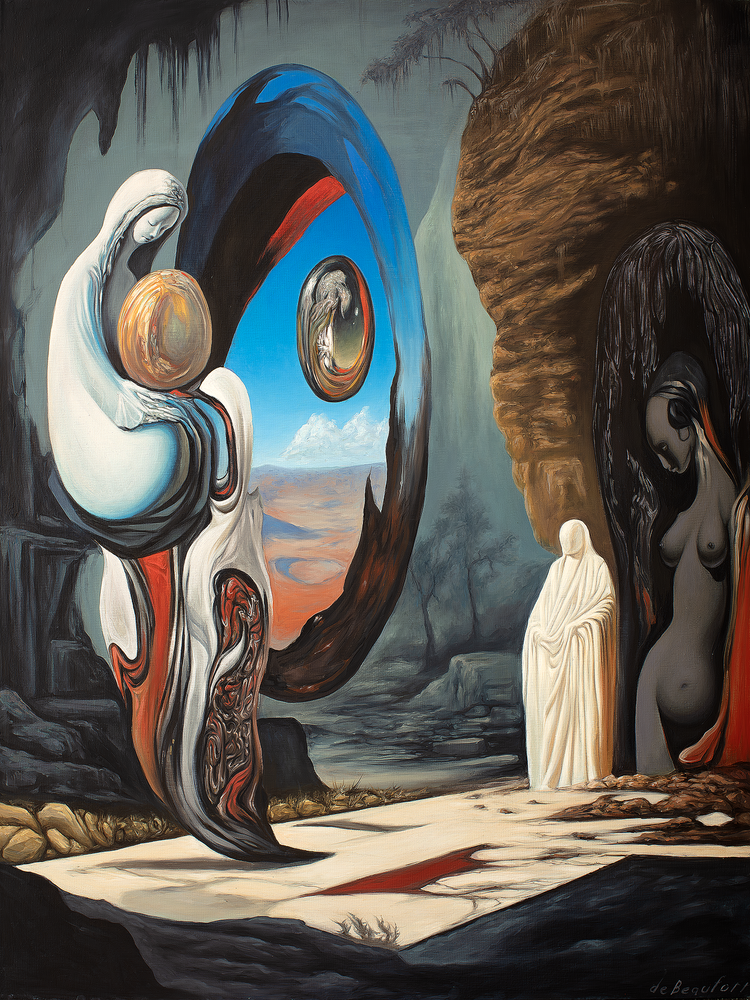
"Influenced by 20th-century Surrealism, vintage science-fiction book covers, and 19th-century Romanticism, I create imagined realms where figures shift, dissolve, and transform. These environments are charged with mercurial energy, suggesting hidden powers that animate our inner selves. After a period of personal and creative struggle, I returned to painting as a means of transmutation. My approach echoes the alchemical concept of the Magnum Opus, a search for the “Philosophers Stone” by working with the prima materia of identity and experience. As my figures bend into existence, they reflect the possibilities for growth, transformation, and the emergence of the integrated self. Alchemy and esoteric traditions are central to my work. Sorcerers and magicians witness or initiate processes of change, protection, and contemplation. Symbols such as the Cosmic Egg and the Eye of Providence embody the Hermetic belief that creativity and imagination are powerful tools for personal development." - www.jacquesdebeaufort.com
Read on below for the full interview...
First of all, how are you and how has this year been for you? Are there any particular ideas or concepts captivating you recently that you would like to share?
I’m doing well—using this time to take stock of the past year and set the ground for what comes next. Lately, I’ve been thinking a great deal about Albert Camus and The Myth of Sisyphus. That line of thought found its way into a painting that took several months to complete, The Burden of Dignity. The work reflects the idea that although life may feel like an absurdist simulation, we must still persevere—if only to maintain our dignity.

The painting presents two entities: a figure seen from behind, a Rückenfigur borrowed from German Romanticism, and a writhing homunculus. The rear-facing figure stands in for both the artist and the viewer-the homunculus is a psychogenic manifestation, burdened by a morphic form that embodies the tension between creative will and its inevitable failure in the world. The painting is ultimately a call to authenticity: answering one’s inner demands while remaining stoic in the face of an indifferent social order. You will fail—but it’s important that you keep going.

What first inspired you to pursue a life of art, and what continues to fuel your motivation as an artist?
I grew up in the Washington, D.C. area, surrounded by museums, and early on I became enthralled by the act of making images. I was the kid drawing and taking photographs while others were playing video games. I briefly tried to pursue something more practical—studying psychology—but it became clear that I was only equipped to make art or teach it.

At this point, image-making is inseparable from my sense of self. Extended periods away from the studio tend to produce a kind of catastrophic disorientation that only resolves once I begin working again. I’m motivated by the belief that I’ve developed some fluency in creating visual experiences that carry weight. Ultimately, I want to move viewers from the literal into something archetypal—using color and form to animate inert material. Translating dream logic into concrete images continues to feel urgent.

What does surrealism mean to you, and how do you see its relationship to dreams and imagination in your work?
For me, surrealism is a disciplined engagement with the subconscious—an attempt to access irrational or dream-based image syntax in order to reveal underlying structures of thought. In my alchemical version of surrealism, figures and objects dissolve, stretch, or mutate, reflecting the instability of identity and perception. I think of my subjects as psychogenic matter—forms that move between worlds and gesture towards the imaginal or occult dimensions beneath everyday reality. They represent transformational processes we all undergo, whether through catastrophic personal breakdowns or more refined, ongoing distillations of identity.

Could you describe your process—both conceptually and practically—when creating a painting?
I compulsively collect images and it's usually something in this vast encyclopedia that sparks an idea. From there I make preparatory drawings in charcoal, which I digitize and then bring into Photoshop. There, I colorize, recompose, warp and edit them before transferring the image onto canvas. These digital drawings can take months or years of work before I feel they are ready. From that point, the painting takes over and is “relatively” quick.

I work primarily in oil on linen or panel, building the image slowly through layers and glazes. An underpainting establishes composition and value, and color is introduced. The process requires patience and ritualistic discipline-the gradual accumulation of intentionality builds at the same time that the image expresses itself. Control and response. A good painting needs to bring you to a breaking point, where it eludes you and humbles you. Once it has you on your knees and prostrate before it with the proper amount of respect given, it allows you to rise and finish it. In the end, you get to Dominate—but you must first submit. If the dance is well performed, there will come a day when the work is pushed over the edge and magically comes alive.

Are there particular artists, writers, or thinkers who have been especially formative for you?
There are too many painters to list meaningfully. Among writers, Robert Graves, J.J. Bachofen, J.G. Ballard, and Philip K. Dick have been especially important. Carl Jung’s writing on archetypes and the collective unconscious has been foundational, offering a way to understand images as both personal and universal. Alchemical and Hermetic texts attributed to Hermes Trismegistus inform the logic of transformation in my work. Joseph Campbell’s The Hero with a Thousand Faces clarified recurring mythic structures. Together, these influences support my belief that art can act as a bridge between the material and the ineffable.

What does spirituality mean to you?
For me, spirituality is an acknowledgment that reality exceeds material explanation. It is less a specific belief system than an orientation—an openness to transformation, uncertainty, and transcendence. In my work, spirituality is embedded allegorically in symbols, dream states, and figures in flux. Art becomes a mediating act, a way of moving between visible and invisible worlds. Ultimately, it’s about meaning-making through imagination—treating creation itself as a form of ritual.
...
Discover more of Jacques de Beaufort's work via his;
- Astral Magazine